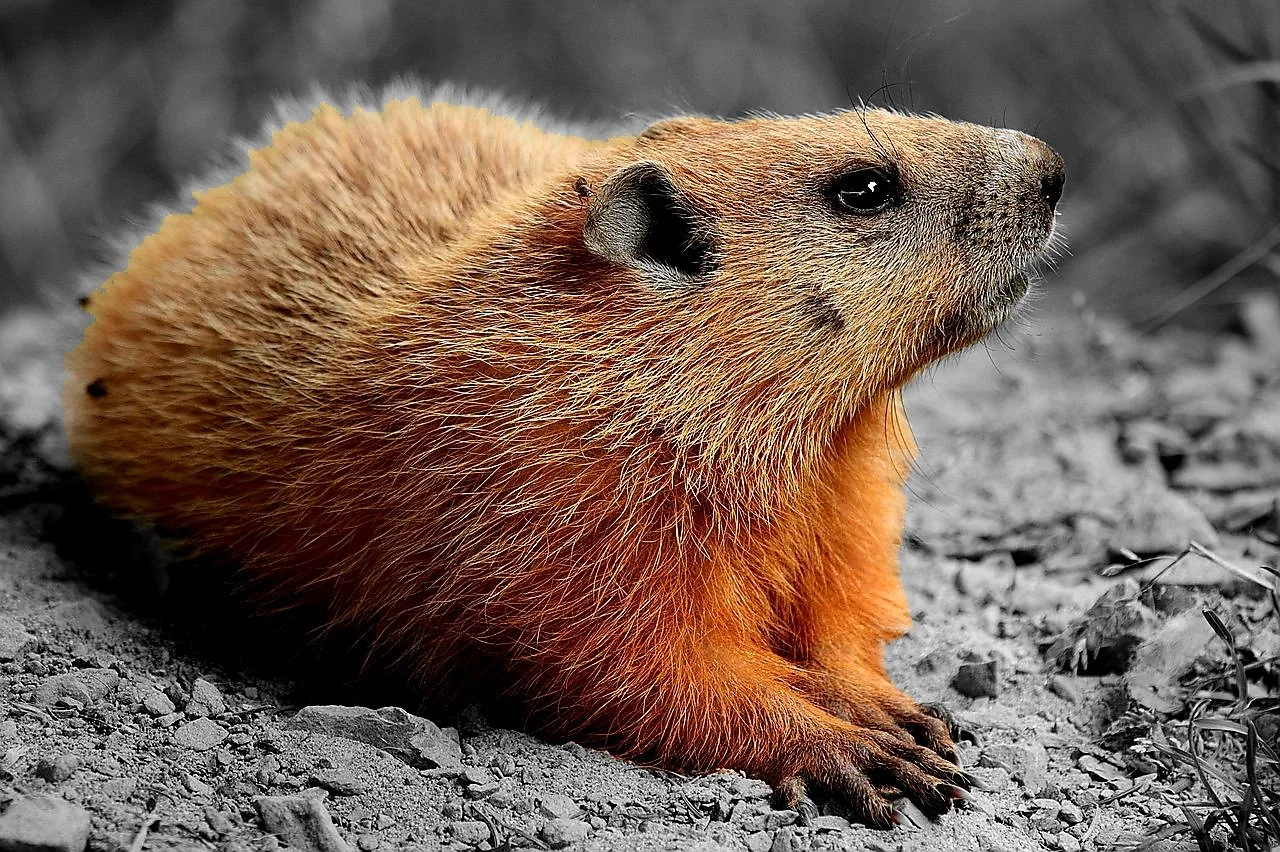
Ground Hog Shadows
Shadows are curious things. They obscure, to be sure. But they also reveal. A shadow is an ephemeral proof that something stands between the sun and the earth, and an indicator that whatever is casting the shadow is somehow real. Vampires are said not to cast reflections in the mirror, and may or may not cast shadows in the sun (we don’t really know, of course, since vampires never show themselves in broad daylight). They don’t appear to cast shadows or reflections because somehow they’re not really as real as we are. At least, that’s what we tell ourselves.
But the groundhog – Marmota monax – makes his appearance at dawn every second day of February specifically to look for shadows and act as a trusty harbinger of the reality of an impending Spring. Nobody’s ever really asked the groundhog (also known as a woodchuck, or a whistlepig) whether he wants to be our seasonal prognosticator. We’re curious about how much wood he chucks (if he even could chuck wood), but we’re not curious about his degree of confidence in the forecast that we annually ascribe to him. Critics bemoan his paltry 35% predictive success rate – somehow parsing whether “early Spring” and “six more weeks of winter” are really that different from each other. But the real wildly unfounded assumption is that his retreating back into his burrow is, in fact, linked to his seeing (and being frightened by?) his own shadow. Maybe he just retreats back into the burrow because he forgot his keys, or remembered that the dryer was still running, or because he simply forgot why he was crawling out of his hole in the first place. A groundhog’s brain is about the size of a golf ball.
Ground Hog Day coincides with the traditional Christian celebration of Candlemas on February 2 – where the liturgical Christmas season concludes, candles are blessed for the year ahead, and sun-shaped crepes or pancakes are greedily consumed. This celebration of light naturally fits in with a custom that entails looking about for lingering shadows. Having endured weeks and weeks of cold and darkness, we express our strong preference for the warmth and light of Mister Sun. Nothing wrong with that. But isn’t it interesting that in just a few short months we’ll be slathering on sunscreen and craving the cool shadows of parasols and Elm trees and backyard patio awnings? Humans are fickle like that. I suspect groundhogs are a bit more… well, grounded.
We should, of course, celebrate Groundhog Day… and Candlemas… and whatever other annual traditions we might create to mark the transition of seasons and the inevitable passage of time. But this year instead of obsessing over the ephemeral illusion of the shadow, try pondering the sun, or the remarkable reality of the shadow-casting rodent. A woodchuck is a furry critter who lives a productive life for 364 days outside of the one day we trot him out for his obligatory photo-op. He swims and climbs and burrows and whistles and otherwise goes about his business unobtrusively, presumably not bothered by the glimpse of shadows. Scientists have found Marmota monax to be the best non-human model for understanding the Hepatitis virus (which this Hepatitis-survivor certainly appreciates).
I once spotted a woodchuck in my backyard, lumbering about in the afternoon sun like he freaking owned the place. It wasn’t really a harbinger of anything… but it was kind of cool to spot one in the wild, and my delight in watching him just do his thing kind of reminded me that it’s OK to just do your own thing. Regardless of the weather, or the season, or the relative balance of sunshine and shadows. The sun rises; the sun sets. Winter will pass, and Spring will arrive.
Like the groundhog, we should enjoy them both while we yet lumber about above the ground. Light some candles. Eat some pancakes. Chuck some wood. Then, maybe go back inside your warm burrow and enjoy a nap. That’s really all that Punxatawny Phil wants you to know.
Happy Groundhog Day!